http://heebnvegan.blogspot.com/2009/12/use-of-animal-products-in-jewish-ritual.html
Interesting discussion about what it means to live a both vegan and Jewish life and the compromises one must consider.
Showing posts with label ecology. Show all posts
Showing posts with label ecology. Show all posts
Monday, December 28, 2009


Tuesday, July 22, 2008
Meeting with the Rabbi
I had my meeting with the Rabbi today. This time, I wasn't so very prepared. I didn't feel like I'd been book-studying as much as I felt I should. He asked me why, and I told him. I've been enjoying my summer and going hiking and camping. I told him about my Shabbat/havdallah set and how I always bring it with me on trips. I told him that I've come to really appreciate Shabbat. There have been a couple of times when I didn't light my candles for some reason, and the day just didn't feel right. I talked about how, as I've integrated the rules for Shabbat into my practice, how the day has become such a pleasure.
I told him that I've been reading the book he lent me, and that it's really helping me to understand not only the meaning behind the words of the liturgy, but also how to let them inspire me. The words themselves are something of a blank slate in terms of emotion, and the worshipper is free to use them to express his gratitude, fear, sadness, or even anger. He can also use them to bring himself to a calm state.
Since I'm also working on reading another book, I told him about that one, too. This was one of the ecology books that I'd found. I told him who wrote it, and the group she is affiliated with. He knew exactly who I was talking about, and was glad that I'd found it. It was definitely a relief compared to the last conversation we had. I talked about one of the essays I had read, about wandering and how it brings out something primal in people. Since I've been watching a lot of The Dog Whisperer, I remembered that Cesar Millan had made a comment about what happens to dogs when they walk behind a pack leader, and how some of the points in the essay were somewhat similar to the ideas that Millan had talked about.
Naturally, this sparked some debate. He asked me if I really believed that the Jews were following G-d around like a pack of dogs, and if that implied that we didn't really have a choice. Of course not. That's what makes us different from dogs. The point was more that, in the wandering, we were forced to share a tight space, to learn how to work together for a common goal, and to accept our place in the group. He kept poking holes in my analogy, which was fine. It was never meant to be a perfect picture, just a way to understand a part of the story in a practical way.
We got in to talking about disagreements, and how religion can actually be a stumbling block to society. This was at least partly because the Rabbi had been at a discussion group last night where they talked about a book that said, at least in part, that atheism might be an important key to world peace. Which I do agree with. I told him so, too. I talked about how that's mentioned in the song "Imagine" more than once (Imagine there's no heaven...no hell below us...nothing to kill or die for, and no religion too). Which, of course, leaves us....where? What role (do I think) religion should have in society?
We talked about that for a while, actually. I think he wanted to hear me talk about religion in a general sense, so as to figure out how much of my understanding is based on Christianity, and how much on Judaism. I talked about how religion, when done correctly, should encourage people to live ethically, and the spirituality should be a pleasant side effect, and I did talk about how I found that in Judaism. He talked about how this might not necessarily be true of Orthodox Judaism. I had an answer for that one: I wasn't sitting in an Orthodox shul. I had chosen Reform for a reason.
It was a good conversation.
Wednesday, June 18, 2008
My Carbon Footprint
Based on a calculator I found at Brighter Planet, I expel 14.7 tons of carbon dioxide into the atmosphere every year. I hope to reduce this as much as possible, even though I'm apparently below the average already.
It makes me feel good that I'm doing some of my part. I think it's a mitzvah.
Monday, June 16, 2008
My Weekend: Hide and Seek
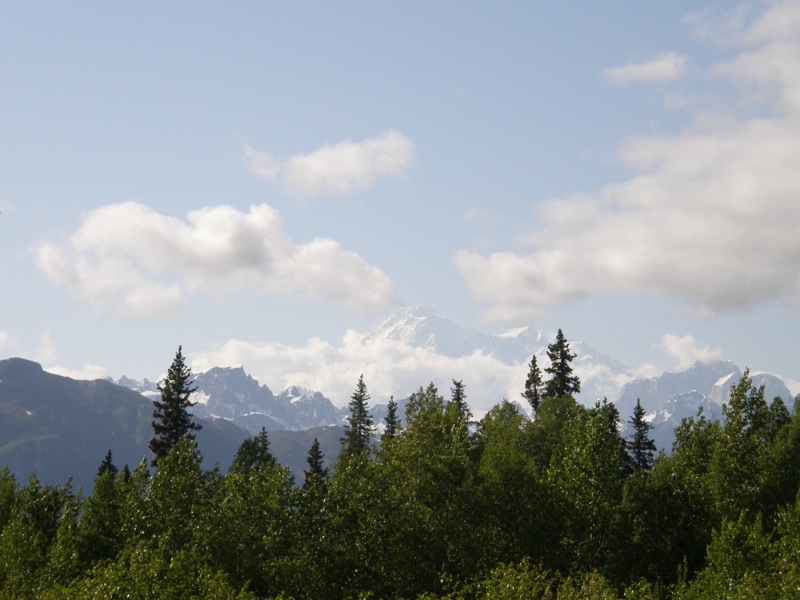
I stayed in a campground near a lake, with a really nice trail that goes around the lake. There was also a trail that went about a quarter mile to a nearby Veterans' Memorial.
The first time I took that trail, it was on a whim. I was walking the dog, and I figured it would be as good a place as any to spend some energy. When I got there, I found that there had been significant improvements to the area. The parks system had built a scenic outlook toward Denali. And not only that, but the mountain was visible, and it was stunning. There were clouds on either side of the two peaks, and another nestled below, at about the level of the surrounding mountains. It made Denali look all the more impressive and mysterious. One of the other people at the outlook said it looked like a ghost, and I wouldn't disagree. Another person gestured to the mountains flanking Denali and pointed out that, at more than 17,000 feet, they would be imposing anywhere else in the world, except next to that particular peak. And it's true. I found myself drawn to that outlook; the dog and I walked there several more times, each time hoping to see the mountain again. We didn't get the chance; it was always hidden by clouds.
It made me think about how wonderful Shabbat time is, that I was able to just drop everything and go for a hike. I realized that I had spent the bulk of my weekend seeking, whether I was seeking a view that few people are blessed to see, seeking a nice rock to rest on, or seeking G-d.
I also started reading a really great book called Ecology and the Jewish Spirit by Ellen Bernstein. So far, I'm through the first section, which is a series of essays about Sacred Place. One of them talks about how Shabbat is similar to being in the wilderness, because of the way you're freed from clock-based time, instead depending on the sun and stars to tell you when to light your candles. The big difference is that Shabbat ends with havdallah, but that there is no ritual to end your time in the wilderness. The author of that essay (whose name escapes me now) said that's why s/he often feels sad when returning to normal life, which is pretty true.
I also realized that I've always had a ritual for ending my outdoor time. A shower. But not just any shower. One that delights in the luxury of warm, running water and the feel of it on my skin. One with a soap that's different from the one I used at camp, one that smells fresh and clean. When I thought about it in my post-camping shower this time, I realized how similar it is to the havdallah ritual in its use of my senses, especially the smelling and the warmth.
Tuesday, June 3, 2008
Meeting with the Rabbi
I met with the Rabbi today, for my consultation in lieu of classes. We talked about the progress I was making with the Hebrew. I think he thinks I'm learning quickly. He gave me a chance to ask any questions that I had, and I didn't have too many yet. There were some words in the book that I was working with that I didn't think I was reading correctly, so he helped me out. The words didn't sound like Hebrew in my mouth. One of my mistakes was that I had confused two letters. You're never going to say the word correctly if you have the wrong letters. So that was an easy fix, really. I didn't know how to pronounce a particular vowel combination, so he helped me with that. He also showed me an ending that was going to mess me up pretty good, because it involved a silent letter that wouldn't usually be silent.
Then we talked about why I'm interested in Judaism and its relationship to ecology. I think he was scared that I was going too new age with it. Its not that at all, really. I think that some of the people who write about that area are doing it with a new agey perspective, but those ideas aren't intriguing in a satisfying way. I mean, it's great to consider the patience of a rock, but ultimately, the imagery fails because patience requires free will or at least some kind of choice. The Rabbi suggested that I try looking at a few scholars he was aware of, and I promised that I would.
For me, the nexus of G-d and nature is valuable. I think that nature forces you to be in the moment. When you appreciate the beauty of the mountains around you, your mind is drawn to the Creator of those mountains; in that moment that takes your breath away, you find G-d. You need to have that same sense of awe when you light the shabbat candles. When you're hiking, you're looking out for bears that might eat you and roots you might trip on. You're not thinking about your laundry or your bills. This is the same mindset you should have when you pray or study Torah.
Since I know a lot more about nature than I do about G-d, it seems like a good way in. A way to teach my mind to focus on G-d and push the distractions to the side. Surely there have been writers, in the past 5000 or so years who have written things that can help me with that. I just wish that I had been better able to explain all of this to the Rabbi. I got about halfway there. When I leave his office, I always think of that genius thing I should have said, because I walk away thinking about the questions he asked and why I was unsatisfied with my own answers.
Sunday, June 1, 2008
Kabbalah on Green: Consciousness and the environment
I picked up this book on a whim at Borders. I'm exploring how Judaism interacts with nature, so the title piqued my interest. And then I saw who wrote and published it, and, knowing how controversial the Kabbalah Centre is among the Jewish community, I thought it would make for an interesting read. It is interesting, but it's also raising a lot of questions, a number of them with Berg's logic. This book report is different than my others. I'm writing this one as I read the book, so it is more of a dialectical than a report or a review.
The first chapter talks about Al Gore and how his Presidential campaign losses were destiny, and if he had not lost, he would not have gone on to do the projects he did. Berg implies that Gore would not have been as green if he had been President. I don't know about that. It can never be disproven, of course, but the fact is that Gore has been a proponent of environmental concerns for a long time now. I remember reading about things he was doing back when I was a kid and really into 50 Simple Things Kids Can Do to Save the Earth. I would argue that Al Gore's green-ness has nothing to do with what happened in 2000 or 2004.
Berg does make a good point about how people tend to think in terms of "cleaning up", rather than preventing a mess. Especially when it comes to the environment. It would be better if we could change our focus and prevent the types of crises we get ourselves into, but, alas. We are who we are. Berg loses me when he moves on to say that our negative thoughts contribute to global warming, because they somehow rearrange or change atoms into pollution and that if we gave off only positive energy, atoms would become beautiful things like roses. As I understand it, atoms are atoms. They are basic and can't be changed from one thing to another. I have a really hard time with that concept. People would need to have the power of G-d for that to work.
He uses a lot of observations of word similarities to bolster his arguments. I don't know enough Hebrew to know if these hold any water. Adam...atom. Wholeness...holiness. They're useful pneumonic devices, but pretty weak evidence.
Lest it sound like I disagree with everything Berg says, or that I read the entire book cynically, I do agree with some of what's written in chapter 3. I agree that G-d manifests himself in nature, and that we needn't look to the Heavens to find G-d; we can look to the mountains and the trees. Berg also talks about how everything is interconnected, which makes sense when you're talking about pollution from the United States having an effect on Southeast Asia. I'm not as willing to believe that lies and disrespect can cause an earthquake. I think Sharon Stone tried to say something like that recently, and it didn't go over too well.
In the end, I did not finish the book. I got to chapter 4 and realized that it doesn't apply to what I'm interested in studying, so it's on the shelf. I'll finish it someday, maybe.
Friday, May 16, 2008
Blog Link: Sustainable Judaism
From Radical Torah: The Questions We Must Ask
I found this really interesting. One of the areas that I'm studying is Judaism and ecology. I came across this blog entry, and it definitely made me think. We usually use the word "sustainable" in terms of green living. Here, that philosophy is applied to spirituality.
It's actually a really strong metaphor. There are people who go to pretty extreme lengths to make environmentally ethical decisions. They buy specific products, avoid certain activities, and are conscious of their impact on the planet.
These are wonderful things to do, and I do them to the best of my ability (and budget).
I think religious devotion deserves those same standards. The Torah asks that of us.
It also asks us to be ethical stewards of the earth.
This just happens to dovetail nicely. Torah certainly is a tree of life.
Subscribe to:
Posts (Atom)

