Just yesterday I was part of a Chanukah service at a hospital, put on by the Jewish chaplain there. It was the first Chanukah at that hospital, which is a Catholic institution, so that was cool. Part of the service involved a speeches by the chaplains and my Rabbi about the origins and meanings of Chanukah.
The Jewish chaplain talked about miracles. The one she highlighted had nothing to do with oil; the story was about a baby that was life flighted to the hospital, her mother, and the chaplain's experience of the whole situation. She talked about spiritually and emotionally supporting the mother, about praying with the mother (who wasn't Jewish), and the joy of the baby's survival. She explained that she felt the miracle wasn't that the baby survived; it was that the doctors did their best. That their best was enough to save the baby was a bonus.
I thought that was a refreshing take on miracles, and a very interesting insight into how a person deals with death and the grieving as a profession. She talked about how Jewish tradition holds that if you save one life, it's as if you saved the whole world. That's a big miracle and a mitzvah. She talked about how important it is to see the small miracles, like the doctors and nurses and the whole medical staff being focused, working together well, and performing at the top of their games. This is also a mitzvah.
She also said that it's important to be surprised by what you encounter in life. If you are shocked at the violence one person can inflict on another, that means you aren't resigned to it, you haven't accepted it, and you can fight against it. If you are surprised when things go well, you can fully appreciate them. She said that she feels you can never be adjusted to what life throws at you; she happily proclaimed that she is the most maladjusted person in the world. I liked hearing that, because I also find that when I'm complacent for a while, it soon follows that I will be unhappy.
I was also very touched by her stories in a more personal way. My Aunt died of cancer just after Thanksgiving. Sometimes it's hard to reconcile seeing how far medical science has come in treating cancer, but still having it not be enough to save a loved one. Some of the fault is her own, because she didn't seek treatment until the very end, but even so...you feel like there should have been more. Don't get me wrong, she defied doctors' expectations twice.
When she went in for an MRI on the Monday before Thanksgiving, they found that the tumors were in bad places near her stomach and had to do emergency surgery; without it she would almost certainly die, and with it there was a pretty good chance she wouldn't wake up, and if she did they expected her to be uncommunicative. Tuesday was a good day for her, though. Her son is in prison, but somehow managed to get out with a 3rd party custodian to pay her a visit and say the goodbyes and all. Wednesday was a bad day; she was depressed about her situation and her physical condition similarly suffered. The doctors thought that she would pass away in her sleep that night.
When I visited her on Thanksgiving, she was entertaining the whole family with her trademark baudy stories and witty quips. She was also eating turkey, mashed potatoes, and pumpkin pie, which really should have been impossible. Things were similar on Friday, because she was a tough old bird. When I saw her again on Saturday night, she seemed slower. Not as funny, and like she was missing that spark she always had. I got scared that she was going when she started talking about my grandmother, who died 10 years ago. Her breathing was very labored, and she seemed like she was in a lot of pain (this resolved when the nurse refilled her machine). My Aunt passed away at 64 years old the next morning.
Even though it was expected, and probably for the best (you can't have a high-quality life from a hospital bed), it's not easy to deal with during such a family and miracle oriented season. Perspective is everything. I think this is part of the reason why it's a mitzvah to visit the sick; cheering them up is important and valuable, as is caring for them. We also need to see the small miracles that happen around them because death and waiting for a miracle that never came can shake a person's faith, but we need to respect and appreciate life and the miracles that do come.
Showing posts with label holiday. Show all posts
Showing posts with label holiday. Show all posts
Thursday, December 17, 2009


Wednesday, December 16, 2009
Why all the fuss about Chanukah?
For much of the American and European (Christian) world, the halls are decked, and 'tis the season to be jolly. Twinkly lights, cheesy spangles, and rampant commercialism fills the air. Possibly in an effort to appear more accepting of alternate traditions, advertisements hocking gifts say "Happy Holidays" instead of "Merry Christmas", or if they say that dreaded C-word they include Chanukah, and Kwanzaa. I've heard many Jews express the opinion that Chanukah is a minor holiday and all the hooplah is purely a figment of the media's imagination.
I think that Chanukah is underrated in terms of the value Jews place on it. Yes, it's a light "party" holiday with a couple very different legends behind it, such that it's easy to be confused as to what, exactly, you're celebrating. But as my Rabbi pointed out, Chanukah is one of the few religious holidays that has historical evidence supporting the events it commemorates: the Maccabee rebellion happened and they did rededicate the Temple after the Greeks desecrated it. My Rabbi also took it one step further: if it weren't for the Maccabees and their reunification of the Jewish people and rededication of the Temple, world history would be completely different.
For example, it's very unlikely that the Christmas story would have even been possible. Due to the fighting at that time between Syria and Egypt, as well the infighting amongst the Jews who supported Syria versus those who backed up the Egyptians, it would have been difficult for the Jewish community to hold a census some 300 years later in the City of David so Jesus could be born there as the prophesies required. It is more likely that the Joseph and Mary would have assimilated and acted like Hellenists instead of Jews, or at the least, been too involved in war for such an undertaking.
I also think that having a Festival of Lights at this time of year is vital, because I live in a place that doesn't have much daylight now that we're approaching Solstice and it's easy to feel a little down because of it. Really, this is one of the reasons why many religions that originated in the Northern Hemisphere have celebrations in mid to late December. It is believed that Chanukah incorporated aspects of a more ancient Solstice practice, but it is known that European pagans celebrated Yule and Christianity chose to celebrate Christmas at a time to coincide with those celebrations in order to suppress paganism (and/or because they felt they really needed a pick me up as the days got shorter).
From a more religious perspective, Chanukah is very much a holiday that celebrates a value near and dear to most Americans: the right and ability to practice religion in a manner of the individual's choosing. When we light our menorahs, we put them in windows in order to publicize the miracle of the oil. We couldn't do that in times of oppression and we're lighting the candles in order to celebrate and commemorate our victory over an oppressive military regime. The Greeks wanted us to assimilate. We wanted our Temple back, so we fought and won. Supporting the idea that it's not just about Jewish freedom is the fact that our victory allowed Christianity as we know it to exist.
Honing in on the Jewish angle, and touching on what you alluded to, Chanukah is a holiday that celebrates the Jewish identity. We came together. We rebelled. We won. We regained the Temple and we experienced the miracles. This is why we bristle at comparisons to Christmas, which in my opinion, is why we tend to downplay its importance. It is certainly the reason that, despite my interfaith celebrations, I reject the term "Christmukah".
Granted, not all Jews celebrate Chanukah, notably those with roots from Iraq and the Eastern parts of the Greek empire. This definitely supports the idea that Chanukah is a secondary holiday. I would never argue that it's as important as Yom Kippur, but I do believe that it has value.
I think that Chanukah is underrated in terms of the value Jews place on it. Yes, it's a light "party" holiday with a couple very different legends behind it, such that it's easy to be confused as to what, exactly, you're celebrating. But as my Rabbi pointed out, Chanukah is one of the few religious holidays that has historical evidence supporting the events it commemorates: the Maccabee rebellion happened and they did rededicate the Temple after the Greeks desecrated it. My Rabbi also took it one step further: if it weren't for the Maccabees and their reunification of the Jewish people and rededication of the Temple, world history would be completely different.
For example, it's very unlikely that the Christmas story would have even been possible. Due to the fighting at that time between Syria and Egypt, as well the infighting amongst the Jews who supported Syria versus those who backed up the Egyptians, it would have been difficult for the Jewish community to hold a census some 300 years later in the City of David so Jesus could be born there as the prophesies required. It is more likely that the Joseph and Mary would have assimilated and acted like Hellenists instead of Jews, or at the least, been too involved in war for such an undertaking.
I also think that having a Festival of Lights at this time of year is vital, because I live in a place that doesn't have much daylight now that we're approaching Solstice and it's easy to feel a little down because of it. Really, this is one of the reasons why many religions that originated in the Northern Hemisphere have celebrations in mid to late December. It is believed that Chanukah incorporated aspects of a more ancient Solstice practice, but it is known that European pagans celebrated Yule and Christianity chose to celebrate Christmas at a time to coincide with those celebrations in order to suppress paganism (and/or because they felt they really needed a pick me up as the days got shorter).
From a more religious perspective, Chanukah is very much a holiday that celebrates a value near and dear to most Americans: the right and ability to practice religion in a manner of the individual's choosing. When we light our menorahs, we put them in windows in order to publicize the miracle of the oil. We couldn't do that in times of oppression and we're lighting the candles in order to celebrate and commemorate our victory over an oppressive military regime. The Greeks wanted us to assimilate. We wanted our Temple back, so we fought and won. Supporting the idea that it's not just about Jewish freedom is the fact that our victory allowed Christianity as we know it to exist.
Honing in on the Jewish angle, and touching on what you alluded to, Chanukah is a holiday that celebrates the Jewish identity. We came together. We rebelled. We won. We regained the Temple and we experienced the miracles. This is why we bristle at comparisons to Christmas, which in my opinion, is why we tend to downplay its importance. It is certainly the reason that, despite my interfaith celebrations, I reject the term "Christmukah".
Granted, not all Jews celebrate Chanukah, notably those with roots from Iraq and the Eastern parts of the Greek empire. This definitely supports the idea that Chanukah is a secondary holiday. I would never argue that it's as important as Yom Kippur, but I do believe that it has value.
Sunday, March 29, 2009
Cleaning out the Chametz
Between Purim and Pesach, it is traditional to clean out the chametz from your home. In the traditional sense, chametz is anything leavened and it's done in order to prepare for Pesach, when Jews are forbidden to possess leavening.
I'm not so traditional. Plus, I share my home with a non-Jew, so I think that simply refraining from eating bread and the like is enough. It is simply not practical to banish non-Passover foods from my kitchen.
But, inspired by a haggadah I read this weekend, I'm still cleaning out chametz. In my case, it's all the extra stuff that I don't need, the stuff that I don't want, and the clutter that makes my life less enjoyable. I spent a couple hours each of Saturday and Sunday, and since it's a 3-day weekend for me, today's the day for some heavy lifting. My focus has been on my bedroom, and it already looks much better. I'm getting excited to see my chametz-free room.
Sunday, March 15, 2009
Pesach
Well, I just made another huge Judaica order, most of it things for Passover. I got a seder plate (with six tiny bowls) and a Miriam's cup. I also got a wine bottle cork and some things to donate to the congregation upon my conversion. I'm excited about them, even though I probably won't host a seder this year.
What will happen is that my mother will join me at the community seder. That ought to be interesting. She still doesn't quite get it, but I think she might get more than I give her credit for. She asked if the temple was going to have an Easter gathering, which is a silly thing, but I think she was just trying to figure out if I was going to be busy on Easter. I hope the seder goes okay.
Saturday, March 14, 2009
If...Then
No, I'm not talking about Jewish SAT questions.
For the past few months, the Rabbi's been presenting us sections from his dissertation on the Exodus and how it happened. He contends that it was not nearly as described. Today's segment focused mainly on geography, and then on wordplay. One of his key points is that when people tell stories, the geography is accurate, even if the story isn't. We all know that Juneau is far to the southeast of Denali, and we'd never describe it any other way. If the Israelites were living in Goshen...then where is that?
One of the first things he talked about was how ancient geographers described locations. Apparently, they were pretty consistent in the words they used and spacial relationships. This makes it especially interesting to uncover the fact that the Hebrew and Aramaic texts say they crossed the Yam Suf. In all other Hebrew and Aramaic texts, Yam Suf refers to what is now called the Gulf of Aqaba, which is on the other side of the Sinai Peninsula from the Red Sea. The first time the text refers to the Red Sea is when it was translated by the Septuagint, and for some reason it has stuck, even though it's inaccurate. This implies that the Israelites weren't necessarily in the Nile Delta. If they weren't in the Nile Delta...then where were they?
The Rabbi made a list of places referred to in the Exodus story, the "itinerary" sites. He then went through the Biblical texts to see how they're described, paying special attention to things like "blank is near blank", and then cross-referencing the known locations and putting them on a map. All of them are east of Egypt, most are northeast of the Sinai Peninsula...not in Egypt. There are records of Egyptians in some of these areas, but not so much about Pharaoh in these places. It's interesting, especially for a geography nerd like me. There's a lot that makes sense about it, because it does pull from the historical record. If we know that Goshen is near Egypt, and Midian is in Saudi Arabia...then what can we extrapolate from that?
Next came the wordplay section of the evening. The Rabbi started with having us read Exodus 1, in which we learn that Pharaoh has decided that the Israelites are "too numerous", so something must be done and in all his wisdom, the best idea he can come up with is slavery. That doesn't work, so Pharaoh decides to be extremely illogical and kill all the boys at birth. The Pharaoh is outsmarted by a couple of midwives, there are still too many Israelites, and Pharaoh decrees that all toddler boys must be killed. In the Biblical text, the Hebrew words for "increase" and "people" appear seven times. That's a significant number, and tends to mean that those words are important in some way. If they're significant...then what are they trying to say?
In another story, the wise Judean King Solomon enslaves the Israelite people in order to build a temple and a palace. He is cruel and the people rebel, and they are unsuccessful. Solomon dies and his son Rehoboam takes over. He is even more cruel, and the people rebel, led by a man named Jereboam. Any guesses what Jereboam means in Hebrew? If you guessed "the people increase"...then you'd be right.
There are more parallels between the Jereboam story and the Moses story. They both fled a leader whose rule they found tyrannical. They both returned after the leader died, confronted the new leader, and brought their people out of slavery. Apparently, their stories align on 14 points, even though I don't remember them right now. This is also a significant number and suggests more than a coincidence. If the two stories are linked...then what does that mean?
The Rabbi suggests that the Moses story is an allegory. Fiction. His theory is that it was written by the Judeans as the Jereboam events were happening as a way of protesting. This is why there's no archaeological evidence of the Israelites in Egypt in the time that the slavery was supposed to have happened. This is why the itinerary sites aren't in Egypt, but are in Moab, Judah, the Negev, the Jordan River valley, and the body of water they crossed was outside of Egypt's defended borders. If the Exodus from Egypt never happened...then what does that mean for Judaism?
It's a very good question. Of course, what the Rabbi did with the story was simply a literary analysis.
The Judeans could simply have noticed the parallels between Jereboam and the oral tradition of Moses and wrote the story in such a way as to point them out.
Since we are dealing with a story that survived orally for hundreds of years before it was ever written down, it could simply be a case of people forgetting or omitting some itinerary sites. This wouldn't explain the lack of archaeological evidence, though.
I don't care if it's allegory or if Moses just existed somewhere slightly different than Egypt. It's still my favorite story in the Bible.
Sunday, December 14, 2008
I can't believe it.
I just got off the phone with my mom. We were talking about holiday plans (I will always celebrate Christmas with my family and exchange gifts with my friends).
She actually asked me if the Temple will be doing a Christmas service. Of course they wouldn't. The cool part was that she asked if there would be any holiday services, which gave me a chance to explain Chanukah a little bit. She kind of gets it.
But I still can't believe that she'd wonder whether Jews would have a Christmas service.
Friday, December 5, 2008
Shabbat
After the lovely Shabbat I had last week, I tried to set myself up for the same thing this week. It pretty much worked. Last week was very special, since a friend was hosting dinner.
This week I was ready again. I had a fairly unpleasant task to do, so I saved it for the end of the day. When I got off work, I felt accomplished. I was ready to leave the office. And the minute I hit that outer door, I noticed that the sun was down and was grateful that Shabbat had technically started.
I wished I was able to go straight home for candles and kiddush, but I had to run errands first. Now that I'm settled in, it's a nice evening. And I feel Jewish.
Tuesday, December 2, 2008
Shabbat rest
This past Friday night, I surprised even myself by declaring that I was ready for Shabbay rest. Maybe the others were surprised because the previous day was Thanksgiving and most people didn't have to work. Me, I was surprised because I had never said that before.
I had been ready for the weekend. I had been glad it was Friday night. But I had never been glad for Shabbat itself.
Part of it may have been because I worked hard last week. It may have been because I was sick but feeling better. It was almost certainly because I had arrived at Carrie's home for another of her wonderful Shabbat meals.
But that was one of those wonderful moments when I really felt Jewish. On the drive to Carrie's, I realized that it was dark and technically Shabbat already, and I felt more relaxed. But once those candles were lit, I really started to feel it. Rest. Shabbat rest. A real, definitive separation between worktime and holy time.
It was beautiful.
I'm not going to lie, though. I did work only hours later, cleaning up after the party had subsided. But even that had a sense of peace about it, because it seemed a part of the dinner, a part of the evening, a part of Shabbat.
I hope I feel that again this week. And the week after that. And every week.
Sunday, June 8, 2008
Blog Link: Shavuot (and my weekend)
This weekend was really disappointing for me. I didn't get to keep Shabbat at all, and for the first time, I wasn't even able to harbor the delusion that I was going to try and it really bothered me.
You see, my bathroom wall decided to give out this past week, and Saturday was the only day my dad would be able to help me demo the old shower surround, because it was going to need a day or so to dry out before we put up new sheetrock. And, of course, the only day we could do that was Sunday, which is also the day the Temple was planning a Shavuot gathering. Granted, we finished putting up the drywall in time that I could have gone to the service, but...my parents were planning to go to a wedding and needed me to watch their dog. Plus, I haven't had a shower since Friday, so I'm not fit for being seen in public.
Ugh. I was really looking forward to talking about the Torah portion at services this week. And the Shavuot all-nighter. Grrr. But at least my bathroom will look good.
I did find this really neat article about Shavuot on Treehugger.com: Explore the Hebrew Holiday of Shavuot that talks about how Jewish holidays tend to have a strong connection to nature and food, and then talks about how that's true for this particular holiday. I loved that it was on a secular blog about nature and living with a connection to the earth.
Saturday, February 2, 2008
Conversion Class
Again, I was the only student in attendance, so it was just me, the Rabbi, and our songleader meeting in the Rabbi's office. If it stays like this, I think I'll like it. The discussion has been very informal, with the Rabbi quizzing me about the week's topic to figure out how much I already know, and then we talk about the rest of what I need to learn. And then we talk about other things.
Today's talk was about Purim, which is a celebration of the Jews' victory over the evil Haman. Except for it may not have ever happened... The story goes that the King of Persia, needed a wife, so naturally, he held a beauty contest. He found a very beautiful woman named Esther, who just happened to be Jewish. She didn't tell her husband that she was Jewish, on the advise of Mordecai, as there was a lot of persecution of the Jews going on in Persia at the time. Eventually, Haman asks the King to order that all Jews should be killed. The King goes along with this, and Esther and Mordecai have a problem with that idea. So Mordecai talks to Esther, and convinces her that she's in a position to save the Jewish people, as long as she risks her life by revealing her true identity to her husband. She does this, and the King gives a very illogical answer: that he cannot reverse his original decree; he can only order that the Jews have the right to defend themselves. Esther and the king also host a dinner and invite Haman. They get him drunk, and then they kill him, as well as all of his sons. After that, the army goes out after the Jews, and they fight back, and there's a bloodbath, with thousands of Persians dying left and right.
The Jews survived, so now we eat and drink to celebrate. And since Haman was brought down with a plan devised by a woman, we mock him roundly. Every year on Purim, the book of Esther is read to the congregation. Every time Haman is mentioned, the crowd is supposed to blot out his name by booing, stomping, or using noisemakers. My Rabbi likes to have people cheer when Esther's name comes up.
Another Purim tradition is that everybody dresses up in costumes. Some congregations only dress up the children. Others restrict the costume choices to characters from the story. Our Rabbi likes to have everybody dress up, and they should wear whatever they want. He said that he's gone as a Renaissance figure, a Star Wars character...lots of things. Some Jewish families also use Purim as an alternative to Halloween.
A vital part of the Purim celebration is eating and especially drinking. Lots of drinking. It is said that we should drink until we can't tell the difference between "arur Haman" and "baruch Mordecai", which mean "cursed is Haman" and "blessed is Mordecai", respectively. That's pretty drunk. It's a day of merrymaking and mockery, and it's kind of like a Jewish Mardi Gras...back in the day when Mardi Gras wasn't about pure debauchery.
Purim is also the only Jewish holiday which prescribes gift-giving. Traditionally, food-gifts are given to friends and family, and money and food is given to charity. It's a mitzvah to give those gifts.
Saturday, January 26, 2008
Conversion Class
I went to class again today. It had been cancelled last week due to a Shabbaton celebration. I was the only one who attended today.
We talked a bit about Havdallah, which is the ceremony that ends Shabbat and begins the regular week. It's celebrated with wine, spices, and a braided candle. The wine is just a standard Jewish thing, according to my Rabbi. He says that any time there's a celebration, there's wine, and there's no special significance to it in this case. The spices are because Jewish tradition holds that we are granted a special extra bit of soul to help us celebrate Shabbat, and at Havdallah, it departs from us. Usually, when your soul departs, if you don't die, you feel faint. When you faint, you get smelling salts to bring you back....in this case, the spices are meant to stand in place of the smelling salts. The braided candle is symbolic for a number of reasons. The two that my Rabbi pointed out to me (that were significant to me) were that Shabbat begins and ends with lighting candles, and that this candle is braided, or woven, to represent paths we take in life, and how we're interdependent.
We also talked about Tu B'Shvat, which is new year for the trees. I really like this holiday, because of its emphasis on nature and hope (but not cheesy hope). It celebrates the cycle of dormancy and growth, because it marks when the sap starts flowing through the tree again, bringing the tree back to life. That's hopeful. It also celebrates that Spring is coming, which is huge for me. Living where I do, Spring seems so far away...
My Rabbi also told me about a Kabbalistic seder that's done on Tu B'Shvat. He says it's really beautiful. From his description, there's lots of wine, lots of fruit, and then a meal. And some readings to go along with it all. If I can talk some of my friends into participating, I just might try it this year.
Sunday, December 30, 2007
Conversion Class: 11-24-2007
Rosh Hashanah and Yom Kippur: the High Holy Days
These holidays are commanded in the Torah.
It was commanded that on the First day of Tishri, there would be a celebration, because that would be the head of the year. Originally, this holiday was not called Rosh Hashanah, and it bore no connection to Yom Kippur. It was merely commanded to be a celebration on that day which included the blowing of the shofar. In modern times, it's the day to begin the process of repentance. It's also a day that is associated with the creation of the universe, and as such, we are to repent with the intention of tikkun olam (making the world a better place).
Some rituals associated with Rosh Hashanah are the blowing of the shofar, eating honey with apples, making round challah, and tashlich. Tashlich is the casting of crumbled bread into flowing waters; this is supposed to represent the casting off of sins.
It was also commanded that on the 10th day of Tishri that there would be a day of atonement. Jews are called to straighten out their affairs with God and to afflict their souls. In modern times, we afflict our souls with fasting. To do that, we eat no food and drink no water.
It is important to realize that Jews believe that God can not forgive sins committed against other people; only the person wronged can do that. Therefore, today's Jews use the ten days between Rosh Hashanah and Yom Kippur to make amends with the people they may have wronged. These days are called the "Days of Awe".
Sunday, December 9, 2007
Saturday's Service: Hanukkah Shabbat
On Saturday, we didn't have a minyan, and the Rabbi was gone visiting his son, but we held service anyway. We didn't do as much in Hebrew as they normally do, because I would have had a lot of difficulty participating, and with only about 5 people, that would be pretty significant.
Otherwise, we talked about the special haftarah portion for Hanukkah Shabbat. It's from Zachariah, chapter 4. It describes one of the prophet's visions, and was chosen to emphasize the spiritual aspects of the holiday over the military side. There's an angel talking to Zachariah, and he describes the rededication of the altar and the menorah.
We also talked about how we can make Hanukkah significant to us in modern terms. It's all well and good to light some candles and spin some dreidels, but there has to be something more to make it worthwhile. Some people talked about Hanukkah and its contrasts with Christmas as a yearly opportunity to celebrate being Jewish and not succumbing to the silliness that surrounds the contemporary celebrations of Christmas. Others talked about the fact that Hanukkah commemorates the re-dedication of the Temple, and that we can use it as a time to re-dedicate ourselves to a Jewish way of life.
Wednesday, December 5, 2007
2nd Night of Hanukkah
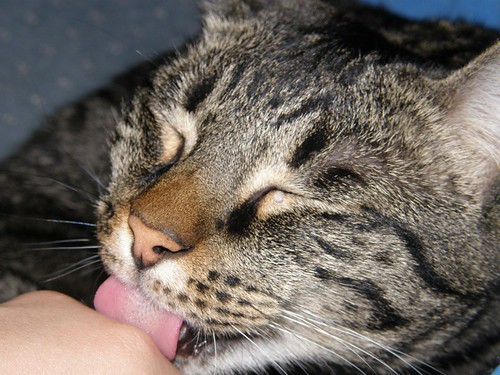
I had to work until 10:30 tonight, so I lit my Hanukkah candles late, but I did manage to do it for the first time.
I'm also celebrating a minor miracle: I found my cat when I got home from work.
The ironic part is that I stayed home from my day job in order to look for the cat. I couldn't take time off from my night job, so I asked my sister to check for him from time to time and left for work.
When I got home, I found him hiding under my boardwalk! I know he wasn't there earlier today.
Hooray for Hanukkah!
News Links: Biblical Archaeology in the News
On National Geographic's website, Eilat Mazar identifies a ruin in Jerusalem as the Wall of Nehemiah. She points to pottery shards and other artifacts to date the structure, and the biblical record to confirm the identity. Not everybody agrees, as the article points out, but it's an interesting theory. For a weak Hanukkah-Nehemiah tie-in, see Faithhacker.
Yahoo News reports that archeologists have found a palace thought to belong to Queen Helena of Mesopotamia. She lived in modern-day Iraq and converted to Judaism in the 1st century C.E. After her conversion, she moved to Jerusalem, and, the theory goes, built a palace that the Romans destroyed when they took Jerusalem in 70 C.E. For a neat Hanukkah tie-in, all this would have been happening right at the time Hanukkah celebrations were first becoming popular.
Tuesday, December 4, 2007
First Night of my First Hanukah
I had intended to observe the holiday in my home, but....
My cat ran away. He charged the door when my sister was letting her dog out. So I spent the evening looking for him. Two and a half hours in the cold, and still no cat. I'm bummed; it's no fun to lose a pet, and it's even less fun on a holiday.
That may be what I get for making plans to go (Christmas) gift shopping with a friend during Hanukkah...
Wednesday, November 28, 2007
Decorations
My mom noticed that I didn't have any decorations around my apartment this year.
Usually, I do just a little something.
Mom's really into crafting, and so our family typically has a lot of handmade decorations all over everywhere at Christmastime. She always puts up a tree that is completely covered in angels and other handmade ornaments. I made some of them as a child; there are a lot of ornaments where we have two on the tree. One is the one that mom made, and the other is the one that I did. Until I turned about 12, mine are definitely a little sloppier than mom's, but she loves them anyway.
Mom loves Christmas decorations so much that she started collecting angels. At first, it was a Christmastime-only collection, but now she keeps some of them up all year. She also has a crèche on display year-round.
So, obviously, she was going to notice that my place doesn't look very festive. In typical mom fashion, she brought me some decorations that she had stored for me, and put them up. I now have a string of quilted mittens at my fireplace, and a stocking hung by the chimney (with care).
Mom means the best with all of this. She's trying to do things that she thinks will make me happy, and remind me of the beautiful things at a time of year where it can be pretty cold and bleak. And she doesn't know that I'm pretty sure that I'm going to go through with the conversion; she still believes that I'm simply learning about Judaism.
It just goes to show that it's not going to be the easiest path. I'll probably never be able to be completely traditional in my observances. Instead, I'll have to find a balance between Judaic traditions and family traditions. I'm sure it can be done, but it's going to take a lot of patience and understanding.
Wednesday, November 21, 2007
Thanksgiving blogs
Faithhacker has a nice post on how Thanksgiving should be seen as a universal American custom, rather than something Jews should avoid for fear of assimilation:
www.jewcy.com/faithhacker/thanksgiving_jewish_holiday
www.jewcy.com/faithhacker/thanksgiving_jewish_holiday
The Chutzpah Chronicles on Faithbook compare Thanksgiving to Shabbat. She says that the way most Americans celebrate Thanksgiving is similar to how she saw Shabbat celebrated in Jerusalem.
http://Newsweek.washingtonpost.com/onfaith/faithbook/2007/11/thanksgiving.html
These are good to know, particularly the faithbook link. I may not have the time to celebrate Shabbat completely now, but it's helpful to have a picture of how God might have intended us to observe the day.
Sunday, November 18, 2007
Conversion Class
In class, we talked about Hanukkah, and we covered a lot of the same information I had written in my previous post on the topic.
New information: Hanukkah or Chanukkah are the most correct transliterations of the word. If you want to be as correct as possible, it should be spelled without the C, but with a dot underneath the H. Nobody does it that way, though.
A menorah is different from a hanukkiah, which is the menorah used on Hanukkah. The menorah was a ritual item found in the Temple, and it had 7 branches. A hanukkiah is meant as a callback to that item, but it has 9 branches and is specifically tasked for the celebration of Hanukkah.
We talked about the two miracles of Hanukkah, and that the military victory story is probably the most true. The Rabbi pointed out that when Hanukkah was first celebrated, the Jews were under oppressive Roman rule, and a victory against the ruling military would, at that time, have seemed like a miracle. Eventually, the story of the cruse of oil was invented in order to create a "legitimate" miracle.
The Rabbi also pointed out that Hanukkah doesn't appear in the Torah, but it does appear in the apocrypha. They talk about the Maccabee rebellion in I and II Maccabees, including the idea that Hanukkah was originally celebrated as a kind of belated Sukkot.
Because the Rabbi is so very interested in history, he pointed out that the story of the Maccabees' rebellion indicates that the Greek army was very disorganized, and that the victory was...more than a little bit based on luck.
The Rabbi also said that he likes to ask his classes about why we celebrate Hanukkah.
He said that the most common answer is "to celebrate the miracle of the cruse of oil burning for 8 days".
After he asks, he likes to continue the class discussion for a few minutes, and then ask, "who believes in miracles?" He says that nobody ever raises their hands.
I would have. I totally believe, but I also believe that miracles aren't always supernatural events. I believe that "miracle" is another word for "luck". I just don't understand how people can have hope if they don't believe in miracles. Lucky there's a holiday just to celebrate miracles.
Subscribe to:
Posts (Atom)

