Wednesday, November 28, 2007

Decorations

My mom noticed that I didn't have any decorations around my apartment this year.
Usually, I do just a little something.
Mom's really into crafting, and so our family typically has a lot of handmade decorations all over everywhere at Christmastime.  She always puts up a tree that is completely covered in angels and other handmade ornaments.  I made some of them as a child; there are a lot of ornaments where we have two on the tree.  One is the one that mom made, and the other is the one that I did.  Until I turned about 12, mine are definitely a little sloppier than mom's, but she loves them anyway.  
Mom loves Christmas decorations so much that she started collecting angels.  At first, it was a Christmastime-only collection, but now she keeps some of them up all year.  She also has a crèche on display year-round. 
 So, obviously, she was going to notice that my place doesn't look very festive.  In typical mom fashion, she brought me some decorations that she had stored for me, and put them up.  I now have a string of quilted mittens at my fireplace, and a stocking hung by the chimney (with care).

Mom means the best with all of this.  She's trying to do things that she thinks will make me happy, and remind me of the beautiful things at a time of year where it can be pretty cold and bleak.  And she doesn't know that I'm pretty sure that I'm going to go through with the conversion; she still believes that I'm simply learning about Judaism.

It just goes to show that it's not going to be the easiest path.  I'll probably never be able to be completely traditional in my observances.  Instead, I'll have to find a balance between Judaic traditions and family traditions.  I'm sure it can be done, but it's going to take a lot of patience and understanding.

Tuesday, November 27, 2007

Saturday's Service: cancelled

When I went to the temple for shabbat morning service, there was no minyan, so we couldn't hold a proper service.  Instead, we talked about the torah portion (Genesis 32:4 - 36:43), which covered the rape of Dinah.

This is an interesting story.  It's not often talked about in Christian churches, and I'd never been taught the story before.  It's a really difficult and confusing passage.  We mostly talked about it in the context of honor killings, and of the marginalization of women in the biblical text.  The Rabbi mentioned a comparison to The Godfather again, this time in reference to Jacob.

I understand it as an unethical overreaction to an incredibly difficult situation.  Key parts of the story are missing.  We don't know how Dinah felt about Shechem.  Even that brings up the question of whether or not that matters.  If it were a date-rape situation, would that make it less wrong?  And if Shechem's actions weren't morally reprehensible, what effect does that have on the reaction of Dinah's brothers Simeon and Levi?  It would seem that their reaction would be even more extreme and difficult to understand, and very unethical.
At the same time, Simeon and Levi come off very badly in the story, and it seems that the author is trying to paint them as unethical.  It's all very much a gray area, though.  Jacob rebukes them at the end of the story, saying that their actions have made him and his people look bad.  It's a very weak admonition, and it's not even the last word in the argument; Simeon and Levi get that, in defense of their actions.

It's an extremely challenging text, and I really don't know what to think of it, other than to realize that there are as many reactions to a situation as there are people.  Beyond that, there are a million ways to interpret the behavior, especially when it's recorded forever in a pretty cryptic fashion.

Monday, November 26, 2007

Blog Link: Faithhacker

This is a topic that I touched on in my opening post, when I talked about the reasons why I was considering conversion.  I'm concerned about the commercial endeavors of churches, the impact on the separation of church and state, and, ultimately, religious freedom.

Faithhacker posted about this very topic.  It's especially interesting to me, because I have attended the church at the heart of this discussion, and even mentioned it in that post.  The Faithhacker post brings up several of the issues which really do bother me: excessive evangelism, and the separation between church and state.

It's kind of sad, really, because I do feel that the ChangePoint people honestly think that they're trying to better the community, and a place like the Sports Dome really could have a positive effect.  I just wish that they had made it a separate entity, as opposed to an extension of the church.  I would want them to pay taxes at an appropriate rate (I don't know if it's for-profit or not).  I would want them to keep the preaching out of it, even though I agree that the code of conduct for their facility is appropriate.
Basically, if it's an athletic facility, it should be treated like one.  If it's really a church where people play indoor football, run track, and practice other sports, then it should be called one.  I don't like the idea of claiming to support religious freedom, but in the same breath talk about converting people to your religion.

If there's one thing that I've learned, it's that committing to a religion should be an act of free will.  It doesn't matter if it's a religion into which you were born, or one you chose for yourself.

Wednesday, November 21, 2007

Thanksgiving blogs

Faithhacker has a nice post on how Thanksgiving should be seen as a universal American custom, rather than something Jews should avoid for fear of assimilation:
www.jewcy.com/faithhacker/thanksgiving_jewish_holiday


The Chutzpah Chronicles on Faithbook compare Thanksgiving to Shabbat. She says that the way most Americans celebrate Thanksgiving is similar to how she saw Shabbat celebrated in Jerusalem.
http://Newsweek.washingtonpost.com/onfaith/faithbook/2007/11/thanksgiving.html

These are good to know, particularly the faithbook link. I may not have the time to celebrate Shabbat completely now, but it's helpful to have a picture of how God might have intended us to observe the day.

Tuesday, November 20, 2007

Accidentally Following Tradition

Another one from The Book of Jewish Practice:
"A biblical commentator, quoted by Nahmanides, noted that Judah chose the name for his first son while his wife named the second (Genesis 38:3-4).  On the basis of this passage he suggested that in ancient times the father named the first child, the mother named the second.  The custom, however is the opposite.  The mother has the choice of name for the first child, the father for the second, and so on."

Oddly enough, my parents followed the tradition.  I'm the oldest; my mother chose my first name.  It was a coincidence, though.  My mom won the right to name me in a hand of cards.
Although...you could argue that it was destined.  If God does not play dice with the Universe, then my mother winning a card game doesn't have to be an accident.

Sunday, November 18, 2007

Conversion Class

In class, we talked about Hanukkah, and we covered a lot of the same information I had written in my previous post on the topic.
New information:  Hanukkah or Chanukkah are the most correct transliterations of the word.  If you want to be as correct as possible, it should be spelled without the C, but with a dot underneath the H.  Nobody does it that way, though.
A menorah is different from a hanukkiah, which is the menorah used on Hanukkah.  The menorah was a ritual item found in the Temple, and it had 7 branches.  A hanukkiah is meant as a callback to that item, but it has 9 branches and is specifically tasked for the celebration of Hanukkah.

We talked about the two miracles of Hanukkah, and that the military victory story is probably the most true.  The Rabbi pointed out that when Hanukkah was first celebrated, the Jews were under oppressive Roman rule, and a victory against the ruling military would, at that time, have seemed like a miracle.  Eventually, the story of the cruse of oil was invented in order to create a "legitimate" miracle.

The Rabbi also pointed out that Hanukkah doesn't appear in the Torah, but it does appear in the apocrypha.  They talk about the Maccabee rebellion in I and II Maccabees, including the idea that Hanukkah was originally celebrated as a kind of belated Sukkot.
Because the Rabbi is so very interested in history, he pointed out that the story of the Maccabees' rebellion indicates that the Greek army was very disorganized, and that the victory was...more than a little bit based on luck.

The Rabbi also said that he likes to ask his classes about why we celebrate Hanukkah.
He said that the most common answer is "to celebrate the miracle of the cruse of oil burning for 8 days".
After he asks, he likes to continue the class discussion for a few minutes, and then ask, "who believes in miracles?"  He says that nobody ever raises their hands.
I would have.  I totally believe, but I also believe that miracles aren't always supernatural events.  I believe that "miracle" is another word for "luck".  I just don't understand how people can have hope if they don't believe in miracles.  Lucky there's a holiday just to celebrate miracles.

Saturday's Service: Mi Shebeirach

Given the news I received on Friday about my friend's son, the prayer for healing took on an extra significance.

Mi shebeirach avoteinu
M'kor habracha l'imoteinu
May the source of strength who blessed the ones before us
Help us find the courage to make our lives a blessing
And let us say: Amen

Mi shebeirach imoteinu
M'kor habracha l'avoteinu
Bless those in need of healing with refuah sh'leimah
The renewal of body, the renewal of spirit
And let us say: Amen

Holiday Cards


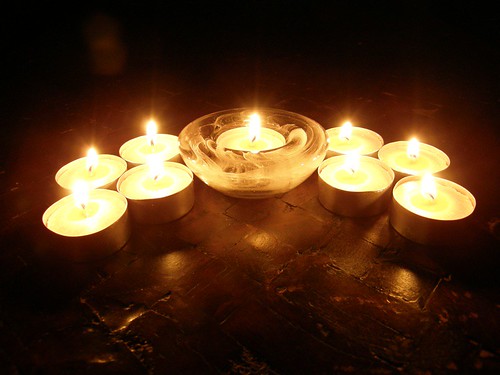
I ordered my cards today.  My inspiration for the image was a kind of deconstructed hanukkiah, with nine candles arranged in more or less a straight line.  
I like how peaceful and calm it looks.
I also like that it's not overtly for any holiday, really, but it won't look out of place in any Christmas card display.
My mother would approve, I think.  Then again, she'll probably just be happy that I'm sending out cards at all.

Friday, November 16, 2007

If you read this

A friend of mine just found out that her son has leukemia today.
She doesn't have health insurance.
The store where we work is going to put together a fund raiser for her, and hopefully that goes well.
It gets worse, too.  Her landlord has decided to sell her apartment, so she needs to find another place to live.  She doesn't know this yet; her mom is going to take care of it while she's in Seattle for 6 weeks for her son to get treatment.
Her mom has also signed her up for Extreme Makeover.  I hope that she gets it; she's a wonderful person who deserves something good to happen to her soon.

If you happen to read this, please pray for her, and for her son.  It would be a mitzvah, I'm sure.

My Notes: Hanukkah

Even though it's one of the few Jewish holidays that I could have named off the top of my head prior to considering conversion, I was surprised to learn that Hanukkah is actually a very minor holiday.  It's mostly just well-known because it's presented as a Jewish alternative to Christmas, but there's really very little correlation, other than a celebration of light.

Most of my information came from MyJewishLearning.com and their Hanukkah section.
HISTORY:
In 164 BCE, the Greeks were forcing assimilation on the Jewish people.  The Greeks took over the Temple and started doing awful things, like sullying the altar by sacrificing pigs.  A family by the name of Maccabee started a rebellion against the Greeks, and eventually won.  Unfortunately, they were unable to clean and re-dedicate the Temple in time for the high holiday of Sukkot, so they decided to delay it a couple months.  This is why Hanukkah lasts 8 days....because Sukkot does, as well.  By this theory, Hanukkah is a celebration of the victory of a passionate, but weak, few against a mighty many.

MYTHOLOGY:
One of the popular Hanukkah stories is that, when they were rededicating the Temple, they found only one jar of kosher oil, which was enough to light the traditional menorah for one day.  It would take 8 days to make more, so they lit the menorah, and God miraculously allowed the oil to last until more was ready.  By this theory, Hanukkah is a celebration of a supernatural miracle.

MEANING:
Hanukkah is about miracles and Jewish identity.  Not everybody believes the legend of the oil, but the successful rebellion of the Maccabees is much easier to swallow.  I think that both stories are important, and each ultimately boils down to restoring the ability to observe Jewish customs.
I think that people need to believe that the impossible can happen with supernatural intervention.  If you can believe in that, then you can always have hope, because even when things are as bleak as they can be, God can change it.  It doesn't mean that he will, and it doesn't mean that if he chooses not to intervene that you're not a righteous person, but it does mean that deus ex machina is possible.  
The other side of the coin is the more people-based miracle; the miracle of a few people defeating a well-trained, well-staffed army.  These are more along the lines of the miracles that happen every day, where people work as hard as they can, and with God's help, they are able to overcome obstacles.  It's important to remember that God doesn't just hand you anything on a silver platter; you have to do your part.

FOR ME:
Even though one of the themes of Hanukkah is Jewish identity and the preservation of a unique culture against the pressures of assimilation, I'm going to continue to celebrate it alongside Christmas.
Before you think I'm just too rebellious, let me explain.

While I very much believe in God in a way that I think is fairly Jewish, and I have found nothing in Judasim with which I disagree, the fact remains that my family will always celebrate Christmas.  On December 25, my mom and dad will expect me to be at their house, sitting next to their Christmas tree, and going to a family dinner.  That's our tradition, and it's a tradition filled with love and bonding.  I'm not giving that up, even though the Christ part is much less significant to me.  We were never into the mass part of it, anyway.
I will have Hanukkah in my own home, and I will appreciate it for what it is.